This story is from an installment of In the Loupe, our weekly insider newsletter about the best of the watch world. Sign up here.
At a seated dinner for 50 people last week on the rooftop of the Hermès boutique in the Miami Design District, a guest admired a photo of the brand’s new H08 Skeleton on a green rubber strap. He’d snapped the image downstairs during a pre-dinner cocktail reception attended by press, influencers and a scattering of clients.
As he contemplated buying the $21,600 piece, he asked: “Is there buzz around Hermès?”
Implicit in the question was a concern about enduring value. “Will I lose money on this watch? Is Hermès sought after by watch lovers?” the prospective buyer seemed to be asking.
It was a question that Laurent Dordet, the CEO of Hermès Horloger, had obliquely addressed earlier in the day, when the brand introduced two new versions of its sporty H08 model at a splashy press event at the Rubell Museum for contemporary art, a setting chosen as much for its provocative art as for its philosophical kinship with Hermès, whose watches celebrate color and playfulness more than most.
“Legitimacy takes time,” Dordet said during a discussion moderated by Geoff Hess, global head of watches and senior vice president at Sotheby’s in New York. “When Hermès started in silk in the 1940s, it took time. The same thing in watches. When Hermès started in 1978, there was a clear ambition—to be as good as its competitors in technique but be different in creativity, materials and playfulness. From day one, the goal was to be at the top level. It’s taken time. But we’re on the way to imagining watchmaking that is different.”
While the house established its watch business in 1978, its real entrée into the world of high-end watchmaking came in 2006, when it acquired the Swiss movement maker Vaucher (followed by the acquisition of a dial- and casemaker).
“For many years, the difference was mainly expressed through style: different shapes, colors, materials,” Dordet said. “Then we started the technical part of our history 20 years ago. From the day we acquired Vaucher, it took six years to get our first movement. Now, having verticalized, it allows us to do more creative features that we couldn’t do earlier.”
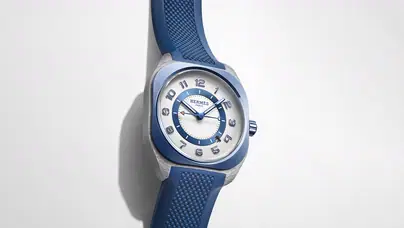
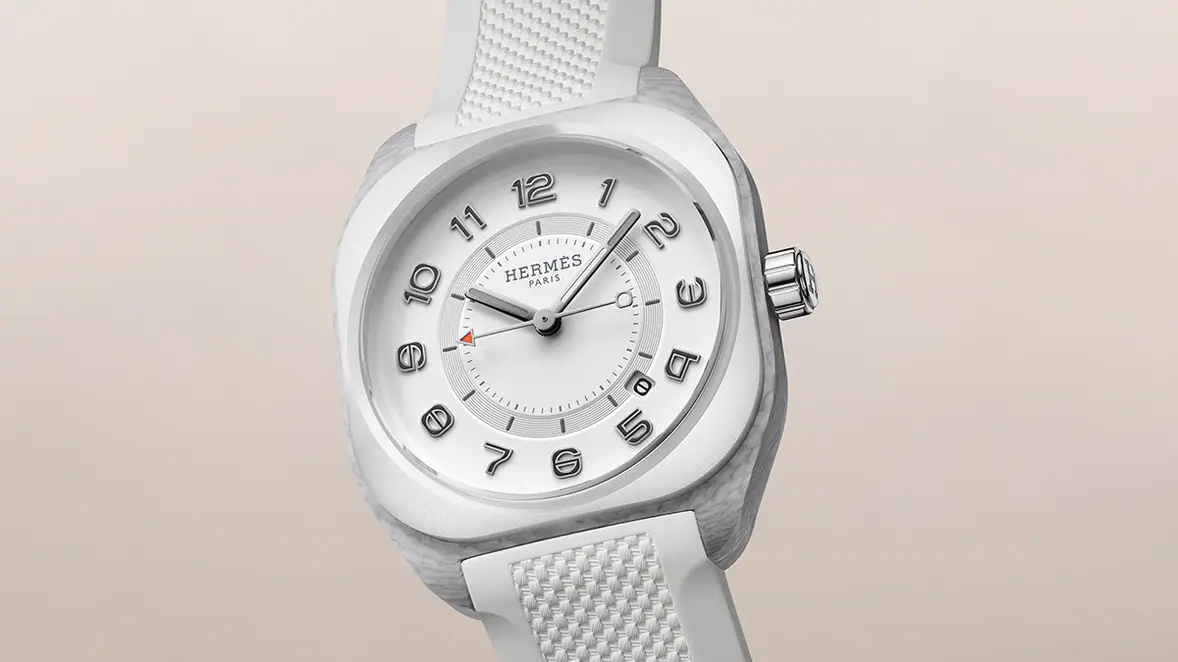
With the new H08 models, those differences play out in the brand’s inventive use of materials. Housed in the H08’s distinctive cushion-shaped case—fashioned from fiberglass with an aluminum-coated, marbled surface—the new iterations features satin-brushed ceramic bezels in white or bleu de Malte, finished with mirror-polished chamfers, and a white lacquered dial bearing ruthenium-treated applied Arabic numerals. Inside ticks the Hermès H1837 self-winding movement, made entirely in-house.
Introduced in 2021, the H08 is one of the brand’s masculine pillars and, according to Dordet, will serve as a platform for more innovations to come. “The idea is: How can you nurture it, make it evolve without betraying it?” he said. “So the values are lightness, robustness. That’s why the skeleton is open without being too open. It has to be robust to be sporty, but it also has to have a design.”
Dordet’s colleague, Philippe Delhotal, creative director at Hermès Horloger, elaborated on the original brief for the H08.
“When we launched the project, we wanted a shape in the vocabulary of Hermès,” Delhotal said. “And the shape came quite naturally. It’s a round shape in a kind of square. For a watch like this, we need lightness, different materials: titanium, carbon. It has an identity that’s very specific and very urban. It’s different from traditional watches.”
The same could be said of Hermès’s entire horological oeuvre, which is steeped in watches that stand out from the usual suspects. Hess, who wore his own Hermès watch to the event, an enamel piece depicting a fantastical giant bird being lifted into the air by hot air balloons, noted that the defining feature of the brand’s watches is the way they celebrate the lighter side of watchmaking.
“We so often speak of watches as important or magnificent or critical—I try hard never to forget that watches are meant to be fun, to elicit joy,” he said. “Hermès hasn’t forgotten the importance of fun in watches. Which is why so many of the watches feature expert craftsmanship, a litany of serious complications, but at the same time are whimsical. I like to say there’s an orchestra on my wrist: hand-carved mother of pearl, animation, balloons spinning. You’re one of the very few brands that’s able to combine whimsy with serious watchmaking.”

In 2011, the judges at the Grand Prix d’Horlogerie de Genève, the prestigious annual awards often likened to the Oscars of watchmaking, recognized that approach when Hermès won the prize for best men’s watch for its Arceau Le Temps suspendu, or “Time Suspended,” model. Delhotal described the watch, and the GPHG win, as a pivotal moment for the brand because it marked the beginning of its interest in unconventional complications.
“With Time Suspended, we wanted to play with time, but differently than others,” he said. “Time is considered a friend, an accomplice. It’s elastic, not always very precise. Let’s try and stop time. For a watchmaker, it’s not something you see very often. So we wanted to take this bet. The outside has this simplicity, this singularity and style. It’s a relatively simple watch. And we were able to express the possibility of suspending time.”
For now, Dordet, Delhotal, and the 600 people who work across the brand’s three factories in Switzerland—at Vaucher, making movements; at another site making cases and dials; and at a third location, where assembly, development, and production take place—are quietly working to ensure that watch enthusiasts like the Miami client contemplating the H08 Skeleton come to see Hermès as a watch brand worth owning.
“The fact is many people don’t know what we do, but as long as we explain it to them and as long as we have time with them, then they shift and consider us,” Dordet said. “We are really young. Our first in-house movement was in 2012. We are still on the road. And our ambition is that each year we have something new to add to our notoriety.”